
Water for Coffee: The Hidden Ingredient That Controls Taste

If coffee is the ingredient you buy, water is the ingredient you brew with. And it decides more than most people realize.
Table of Contents

Coffee is mostly water. So if your water tastes flat, overly chlorinated, or too mineral-heavy, your brew will show it.
The goal of this guide is not to make things complicated. It’s to give you a technical but usable framework:

  • what matters in water (hardness, alkalinity, TDS, chlorine)
  • why it changes flavour
  • what to do about it, without guessing [Read more]

The 4 water variables that actually change your coffee

1) Hardness (calcium + magnesium)

Hardness affects extraction because calcium and magnesium interact with flavour compounds in coffee. Research on brewing chemistry suggests magnesium-rich water can increase extraction of certain coffee compounds, while high bicarbonate (linked to alkalinity) can flatten perceived brightness. [Read more]

2) Alkalinity (bicarbonate buffer)

Alkalinity is not the same as pH. It’s your water’s buffering capacity, and it directly affects how coffee’s acids taste in the cup. Higher alkalinity can mute acidity and shift perceived balance. [Read more]

3) TDS (total dissolved solids)

TDS is a broad measure of what’s dissolved in water. Too low can taste thin and extract poorly. Too high can taste heavy and dull.

4) Chlorine and chloramine

These are common in municipal water. They can create off-flavours, especially in lighter brews, and they are one of the easiest issues to fix with carbon filtration.

The Specialty Coffee Association target range (a practical benchmark)

If you want a clean target to aim for, the Specialty Coffee Association’s water standard is commonly used as a baseline. It provides recommended ranges for key parameters (hardness, alkalinity, TDS, pH). [Ref 1]

Quick targets:

  • TDS: 75 to 250 ppm
  • Total hardness (as CaCO3): 50 to 175 ppm
  • Alkalinity (as CaCO3): around 40 ppm (often cited as a target)
  • pH: around neutral (near 7) [Read more]

H2: Why minerals can make coffee taste better (or worse)

A useful mental model:

  • Magnesium tends to support extraction in a way that can increase perceived flavour intensity.
  • Bicarbonate buffers acids and can reduce sharpness, but too much can make coffee taste flat.
  • Sodium-softened water can be a problem for flavour, even if it prevents scale. [Read more]

That’s why “hard water is bad” is an oversimplification. The type of hardness matters more than the idea of hardness. [Ref 3]

Water and acidity (why your pour-over can taste sharp or dull)

Acidity in coffee is not “good” or “bad.” It’s one of the main structure elements.

If your brew tastes:

  • too sharp or sour, your water may be too low in buffering capacity, or your extraction may be too low.
  • too dull or flat, your alkalinity may be high enough to mute acids, or your extraction may be too high.

A practical takeaway from water research writing in coffee is that alkalinity often matters more than pH for how acidity is perceived in the cup. [Read more]

Want method-specific fixes? Visit Brew Guides

Temperature and water amount are part of the same system

Water is not just chemistry. It’s also heat and ratio.

Even with perfect mineral balance:

  • cooler water tends to slow extraction and can emphasize sourness
  • hotter water extracts faster and can emphasize bitterness if pushed too far
  • changing brew ratio changes strength and changes how you perceive acidity and sweetness

If you want consistency, keep these stable while you troubleshoot water.

How to diagnose your water in the real world (no lab required)

Start with the simplest signals:

  1. Taste your water at room temperature
    If it tastes plasticky, pool-like, or metallic, your coffee will carry it.
  2. Look for scale
    If your kettle builds scale quickly, hardness is likely high.
  3. Check your local water report
    Many municipalities publish hardness and alkalinity. This is the fastest path to real numbers.
  4. Use basic tools
  • inexpensive hardness strips
  • a basic TDS meter (not perfect, but useful)

H2: Fixes that actually work (from easiest to most controlled)

Option A: Carbon filtration (most common win)

A carbon filter can reduce chlorine and improve taste immediately.

Option B: Use consistent bottled water (easy consistency)

If your tap water is inconsistent seasonally, bottled water can be a stable baseline. Not all bottled water is good for coffee, so check mineral content.

Option C: RO water plus remineralization (most controlled)

Reverse osmosis strips minerals. Coffee brewed with fully demineralized water can taste thin or extract unpredictably, so people often add minerals back in controlled recipes. If you go this route, use established formulations rather than improvising.

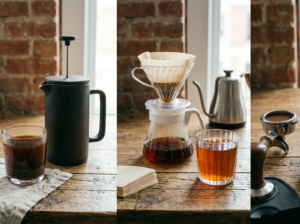
Method-specific guidance (espresso vs pour-over vs immersion)

Espresso

Espresso is more sensitive because it’s a high-concentration extraction. Water that is too hard can cause scaling issues, while water with poor buffering can make shots taste sharp.

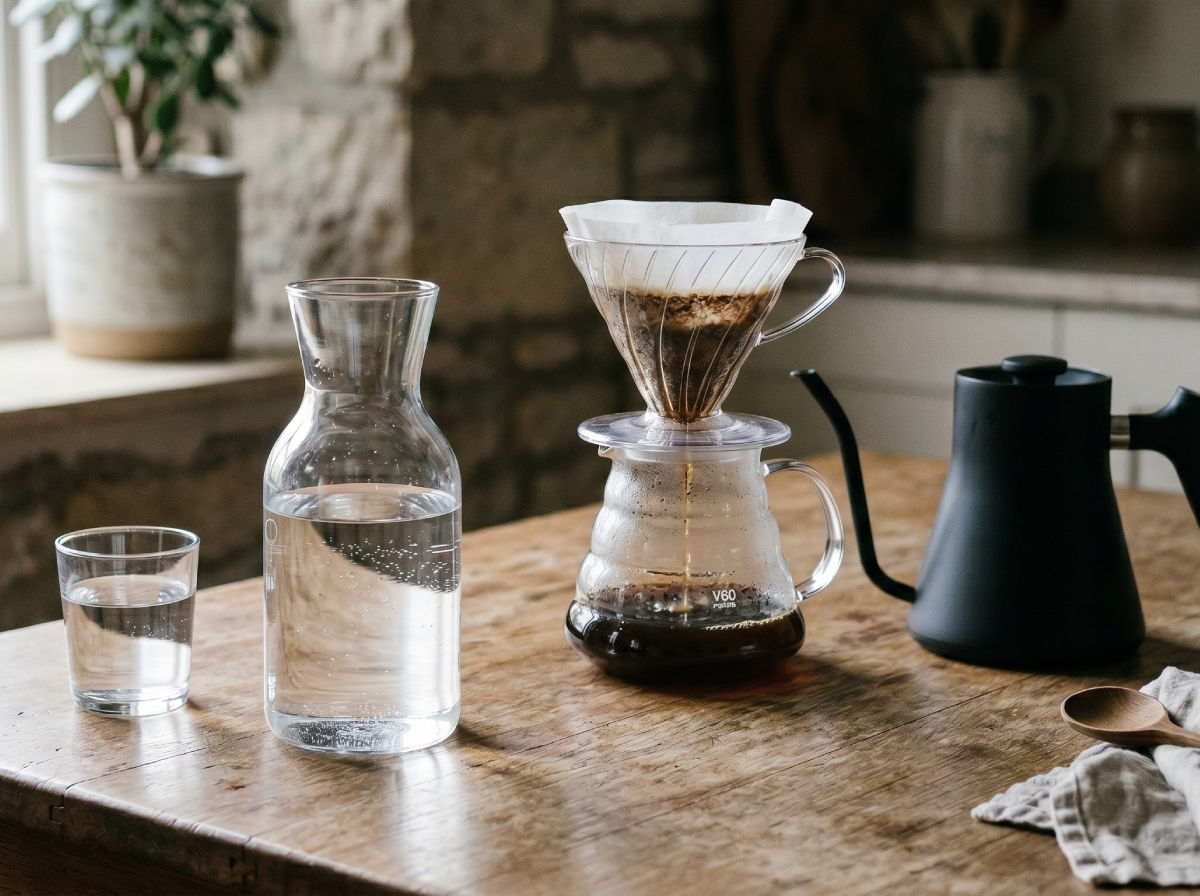
Pour-over

Pour-over exposes water chemistry more clearly. If your pour-over tastes harsh or thin, water is often the first lever to test.

Immersion (French press, cold brew)

Immersion tends to emphasize body. Water that is slightly higher in hardness can sometimes feel fuller, while high alkalinity can still flatten brightness.

Explore step-by-step methods

Test water with Rock Paper Coffee

If you want to actually learn what your water is doing, pick one coffee and brew it repeatedly while you adjust only water! Shop here

Closing

Better water won’t turn bad coffee into great coffee. But it will stop good coffee from being held back.

Once water is stable, every other brew adjustment becomes easier, more repeatable, and more satisfying.

William, CEO of Rock Paper Coffee”
Quote: “Coffee always wins.

share this page:

Facebook
Twitter
Pinterest

Leave a Reply

Your email address will not be published. Required fields are marked *

Still hungry? Here’s more