
The method you choose changes how that extraction happens, which changes everything you taste: clarity, body, sweetness, bitterness, and how forgiving the brew is when your grind or timing is a little off.
This guide breaks down the three core families:
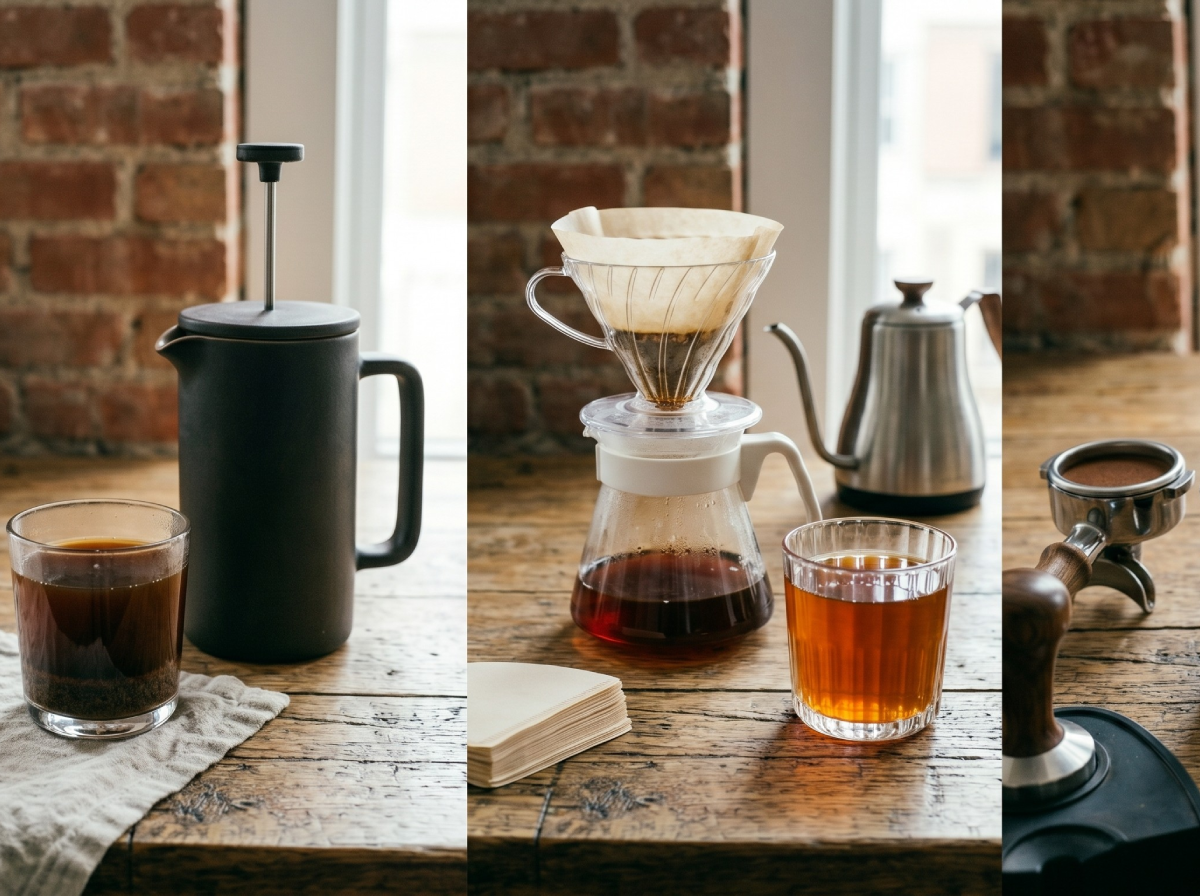
The biggest difference between brewing methods is contact style:
Coffee sits in water for the whole brew. Extraction is more uniform and usually more forgiving.
Fresh water moves through coffee and a filter. This tends to produce higher clarity, but it’s more sensitive to grind and pouring technique.
Water is forced through a compact coffee puck under pressure. It’s fast, concentrated, and extremely sensitive to small changes.
If you’ve ever wondered why French press tastes rounder, why pour-over tastes cleaner, or why espresso can swing from perfect to harsh so fast, this is why.
Immersion is the easiest way to get a satisfying cup without chasing perfection. Because the coffee and water spend the whole brew together, it tends to emphasize body and roundness, and it hides small inconsistencies better than pour-over.
1:15 (example: 30 g coffee to 450 g water)
medium-coarse (like coarse sand)
~92-96°C (just off boil)
4 minutes, then press slowly
Finish: Pour immediately. Don’t let it sit on the grounds
Immersion Does well: body, comfort, consistency
Immersion Doesn’t do as well: ultra-clean clarity, filters remove more oils and fines
If you want that big cup feeling, especially in winter, immersion is the easiest way to get there without needing perfect technique.
Want a coffee that stays smooth in immersion brews? Shop Coffee.
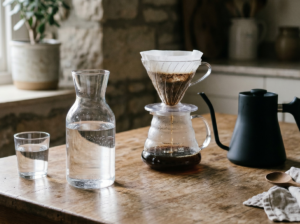
Pour-over is about control. Water moves through coffee and a paper filter, which means you get clarity, brighter aromatics, cleaner finish, more separation between tasting notes. Small changes in grind size or pouring speed can shift the result noticeably.
1:16 (example: 20 g coffee to 320 g water)
medium (a bit finer than table salt)
92-96°C
~2:30 to 3:30
Paper filters catch more oils and fine particles. That’s why pour-over often tastes more transparent and less heavy than French press, even if you use the same coffee.
If you want a step-by-step version read our Brew Guides.
Espresso is its own world. Instead of steeping or slowly flowing, espresso uses pressure to extract quickly from a compact coffee puck. That produces a concentrated drink with a different texture and intensity.
A widely referenced “classic” espresso benchmark is about 25 ml in the cup with a persistent crema, balanced bitterness, and clean aroma.
Many espresso standards also describe parameters like ~7 g of coffee, ~9 bar pressure, and ~25 seconds as a traditional reference point for a single espresso style.
18 g in (double basket)
fine (espresso-specific)
36 g out (1:2 brew ratio)
25-30 seconds
This isn’t the only way, but it’s a stable baseline. Once you’re consistent, you adjust one thing at a time: grind, then dose, then yield.
If you’re brewing espresso at home, look for coffees built for that style. Start with ourColombian Espresso.
If you’re choosing a brewing method based on real life, here’s the simplest way to do it:
No matter what method you use, most bad coffee problems come from the same three variables.
Coffee is mostly water, so water quality shows up immediately. A commonly cited specialty range emphasizes clean water, brewed hot (roughly 92-96°C), and mineral content that doesn’t flatten flavour.
Grind controls speed:
Ratio is your steering wheel. If a brew tastes heavy or intense, increase water slightly or reduce coffee. If it tastes thin, do the opposite.
There’s also a classic target zone, often used for brewed coffee strength and extraction. One widely referenced range describes 18-22% extraction yield and about 1.15-1.35% total dissolved solids (TDS) as a benchmark for filter-style coffee.
Most likely: under-extracted.
Fix: grind a bit finer, brew a bit longer, or increase water temperature slightly.
Most likely: over-extracted.
Fix: grind slightly coarser, shorten brew time, or lower temperature slightly.
Too fast: grind finer.
Too slow: grind coarser, pour more evenly, avoid clogging fines.
Most likely: uneven puck prep.
Fix: distribute grounds evenly, tamp level, and tighten grind consistency before changing anything else.
A brewing method is only as good as the coffee you put into it. The goal is not complexity. It’s a cup that shows up consistently, especially on real mornings when you don’t have time to babysit variables.